



Digital transformation in the healthcare sector often stops at the administrative level: electronic medical records, online queue systems, or a simple chatbot on the website. Yet the most frequent point of contact between patients and the hospital actually happens by phone: asking about doctor schedules, confirming appointments, or simply asking whether BPJS can be used at a particular clinic. This is where voice-based Agentic AI has the greatest chance of making a real impact, as long as it is designed with care proportional to its risks.
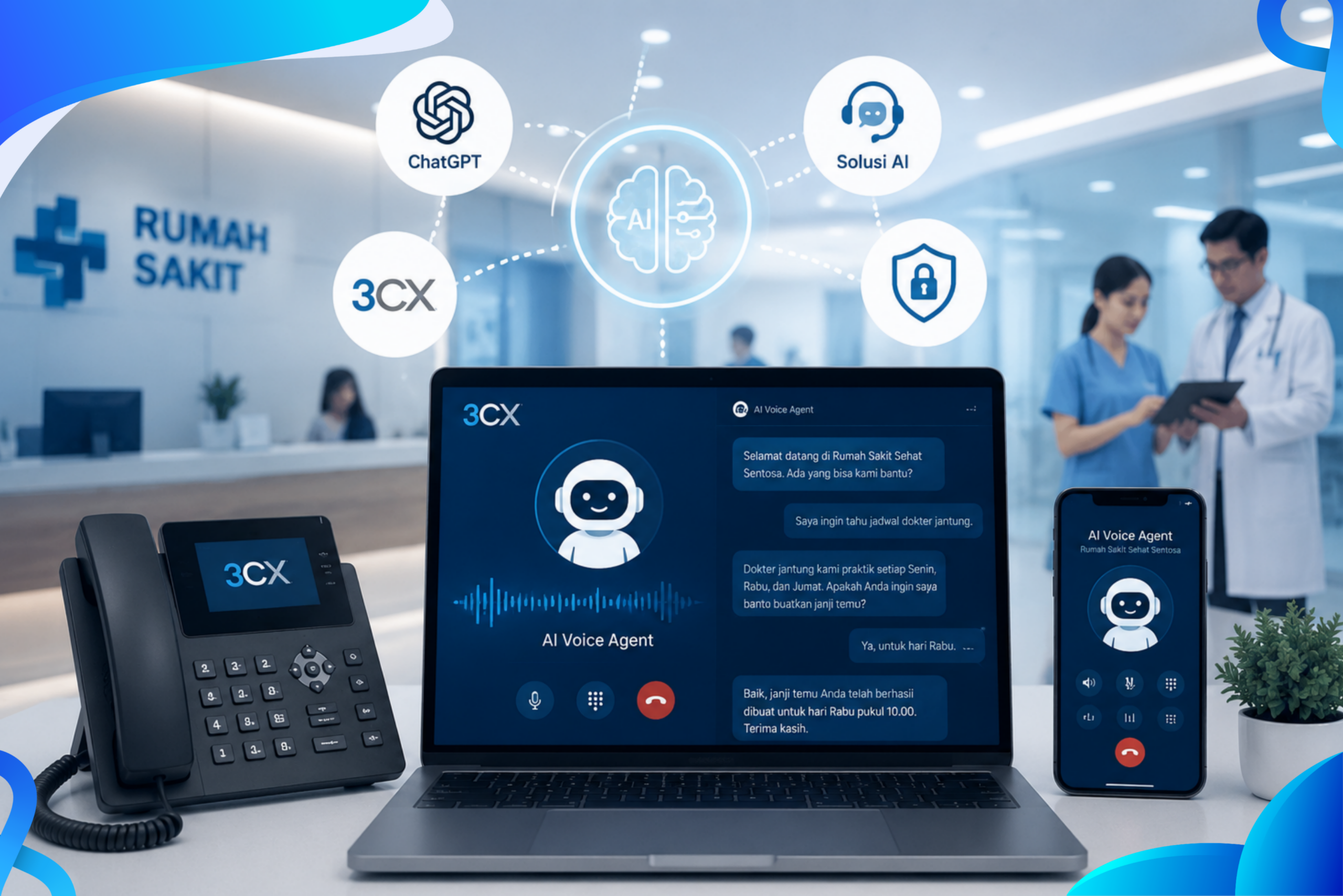
This article discusses an initial architecture design for an AI-based hospital that combines 3CX Cloud PBX as the communication backbone, ChatGPT as the language understanding and conversation orchestration engine, and an AI Solution as the voice engine (speech-to-text and text-to-speech). This combination lets a hospital build an AI Voice Agent that can answer patient calls naturally, while still maintaining strict safety limits.
Why Hospitals Are Different from Other Businesses
Before getting into the architecture, it is important to state one principle: a hospital is not an ordinary call center. An AI mistake in a commercial context at worst leads to a disappointed customer. In a healthcare context, the same mistake can lead to patient safety risk. For that reason, this system design is built on three basic principles:
- AI helps with administrative and information processes, not replacing medical judgment. The initial triage done by AI only works as routing, directing patients to the right clinic or unit, not as a diagnosis.
- Human fallback is mandatory, especially for emergencies, unclear complaints, or requests beyond the AI’s capacity.
- Patient data is sensitive data. Compliance with the Personal Data Protection Law (PDP) must be the foundation from the initial design, not an add-on at the end of the project.
The Four-Layer Technical Architecture
This system design consists of four interconnected layers.
Communication layer: 3CX Cloud PBX. All patient calls, whether from conventional phones or WhatsApp and web calls, come in through 3CX as the communication control center. 3CX handles the SBC (Session Border Controller), basic IVR, and routing calls to the AI path or directly to human staff as needed.
Orchestration layer: AI Orchestrator Middleware. This is the connecting layer that receives audio from 3CX through a webhook or API, passes it to the appropriate AI engine, then returns the result to the call path. This middleware keeps the hospital’s business logic (identity verification, emergency keyword detection, escalation rules) centralized and auditable, regardless of which AI engine is used behind it.
AI engine layer: ChatGPT and an AI Solution. ChatGPT acts as the conversation brain: understanding the patient’s intent, running the needs-diagnosis flow, and composing responses. The AI Solution handles the voice side: turning the patient’s speech into text (STT) and turning the AI’s reply into natural speech (TTS). This separation matters because both engines can be replaced or upgraded independently without changing the whole system.
Integration layer: SIMRS/EMR and human agents. The results of the AI process are passed to the hospital management information system for medical record updates, scheduling, or CRM logging, or escalated to human staff when conditions require it.
Use Cases, Starting from Low Risk
The recommended approach is not to automate everything at once, but to proceed in stages based on risk level.
Early stage: low risk, impact felt quickly:
- General information: operating hours, clinic locations, doctor schedules, BPJS/insurance procedures
- Automatic follow-up appointment reminders through outbound calls or WhatsApp
- Queue number taking with a callback system, so patients do not need to wait on the phone
Middle stage: requires deeper integration:
- Appointment registration directly into the SIMRS, including real-time checking of doctor slots
- Pre-screening of mild symptoms to determine the destination clinic, with an explicit disclaimer that this is not a diagnosis
- Patient identity verification through the medical record number or NIK before giving sensitive information
Advanced stage: requires a strict SLA and ongoing supervision:
- Automatic follow-up after inpatient or outpatient care
- Notification that lab results are available without reading out the results, simply directing patients to the portal or counter
- Call sentiment analytics for service quality control
There are limits that are deliberately not crossed: the AI is not given the authority to diagnose, interpret laboratory or radiology results, or recommend medication. As soon as the system detects keywords indicating an emergency (chest pain, shortness of breath, heavy bleeding), the call is immediately transferred to the emergency unit or human staff without any extra process.
Read about technology in the healthcare world here
A Structured Conversation Flow Pattern
So the AI does not immediately “sell a solution” before understanding the context, every conversation follows a fixed order: initial verification of who is calling and what they need, urgency detection at the start of the conversation rather than at the end, structured information gathering before directing the patient, execution of the appropriate action, then confirmation of the result while always keeping open the option of speaking with human staff. This order prevents the AI from rushing to give answers before truly understanding the patient’s situation.
Security and Compliance as a Foundation, Not an Add-On
Because it deals with health data, the following cannot be negotiated:
- Explicit consent from the patient for data processing by AI, including call recordings and transcripts, in line with the PDP Law
- Mandatory identity verification before opening any medical record information over the phone
- A clear retention policy for recordings, transcripts, and sentiment analysis results
- The principle of least access: the AI Orchestrator is only given access to relevant data in the SIMRS, not full access
- An audit trail for every important decision made by the AI, especially when routing to a clinic or escalating
Implementation Roadmap
Phase
Focus
Estimated time
Discovery
3CX sizing, SBC placement per unit, DID numbers, basic IVR, mapping existing processes
2–4 weeks
AI Agent Pilot
Trial of FAQ and automatic reminders on one low-risk use case, validated by the internal team
4–6 weeks
SIMRS Integration
Appointment registration, identity verification, limited pre-screening
6–10 weeks
Scale and QA
Analytics, sentiment monitoring, ongoing prompt refinement, evaluation of the human escalation ratio
Ongoing
What Hospitals Need to Prepare
The success of this project depends not only on technology, but also on organizational readiness: the hospital IT team needs to be accompanied by a person responsible from the medical side to validate the initial triage flow, API access to the SIMRS/EMR in use must be confirmed to be available (whether through the HL7/FHIR standard or a custom REST API), consent and privacy policies must be reviewed by the hospital legal team, not just the IT team, and emergency escalation SOPs must be tested end to end before the system is actually used by patients.
Closing
Bringing AI into patient service does not mean replacing the human role with machines. Instead, AI can be used to reduce repetitive work such as answering general questions, giving schedule information, reminding appointments, and routing calls so hospital staff can focus more on needs that require human handling.
With 3CX as the communication foundation, ChatGPT as the conversation understanding engine, and an AI Solution as the voice technology, hospitals have an approach that can be developed in stages. However, every implementation still needs to pay attention to data security, the limits of AI authority, system integration, and escalation mechanisms to humans.
For hospitals that want to explore applying this technology, the first step does not have to be building a complex AI system right away. Start by mapping patient communication needs and determining the use case that is safest and gives a real impact.
SolusiPBX is ready to help discuss those needs and design a 3CX-based communication solution that can be developed toward AI-based patient service.
that truly need human judgment. With 3CX as a communication foundation already proven in enterprise environments, and the combination of ChatGPT and an AI Solution as the conversation and voice engine, hospitals have a realistic path to start this transformation, as long as it is built in stages, with clear safety guardrails from the start.