


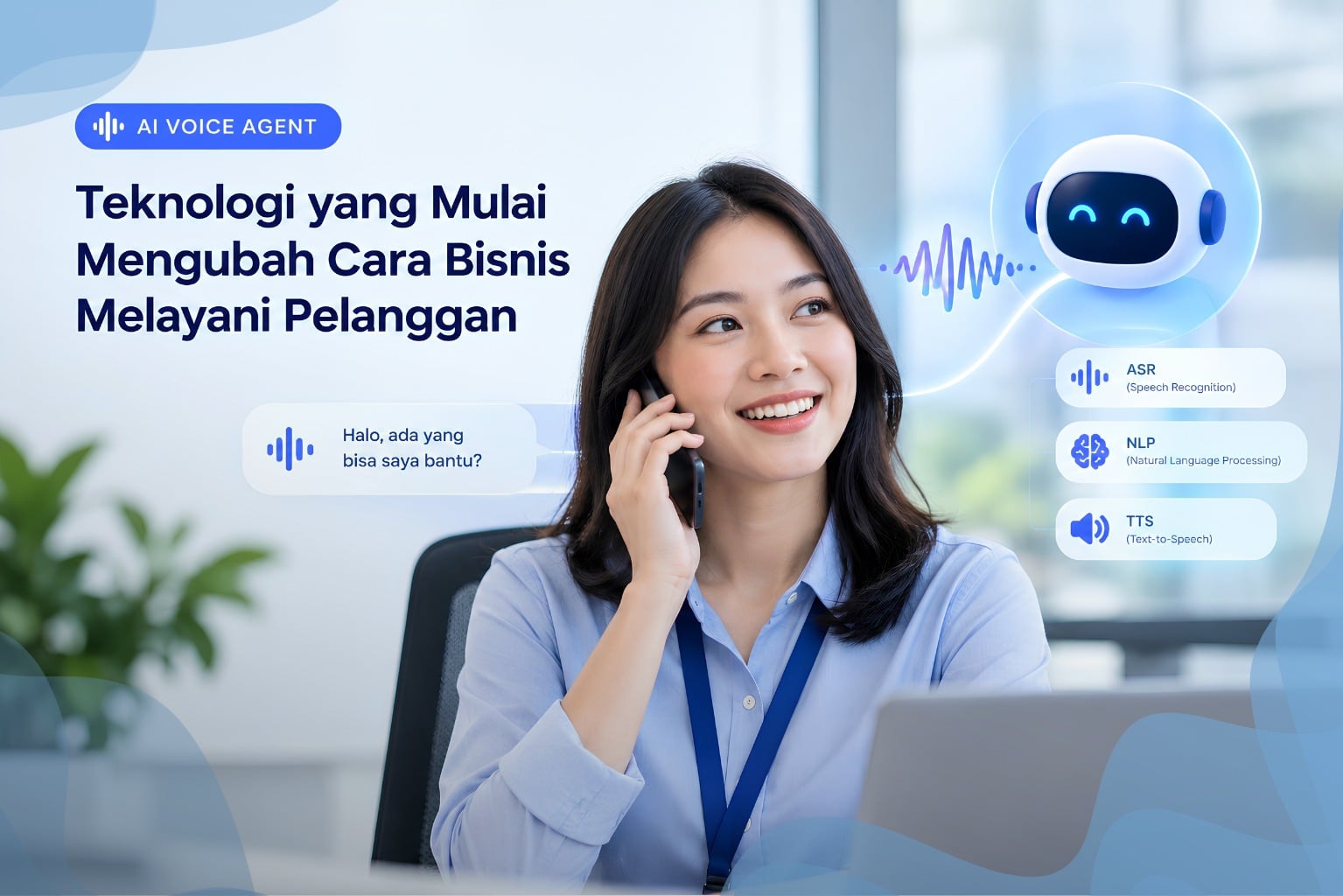

Voice-based customer service in Indonesia is entering a new chapter. After years of relying on conventional call centers and rigid IVR systems, more and more companies are turning to AI Voice Agents: AI-powered voice assistants that can understand, respond, and even make decisions in phone conversations naturally, without a fixed script and without waiting for a human agent to become available.
From Simple Chatbots to Assistants That “Listen”
Until now, customer service automation in Indonesia has been synonymous with text chatbots on WhatsApp or websites. But the trend is shifting toward voice. Unlike traditional IVR, which only offers a limited menu of options (“press 1 for…”, “press 2 for…”), AI Voice Agents combine speech recognition (ASR), natural language processing (NLP), and speech synthesis (TTS), so they can understand a caller’s intent in context and respond with human-like intonation.
Several technology solution providers in Indonesia have begun developing AI Voice Agents to help companies handle customer communication needs without doing it all manually. They also ensure the system can be integrated with the platforms the company already uses, so communication stays consistent. This lets human staff focus on cases that require decision-making or greater complexity, instead of being stuck answering repetitive questions.
Why Now?
Several drivers make this moment feel different from earlier AI trends:
- Ever-growing communication volume. Businesses in logistics, banking, insurance, and e-commerce face surges in calls, especially during peak periods such as Harbolnas or the holiday season. AI Voice Agents allow companies to handle these surges without drastically increasing staff.
- Pressure to cut costs. Voice automation has the potential to significantly reduce contact center operating costs compared with a fully human-agent model, while keeping service available 24 hours a day.
- Changing customer expectations. Indonesian customers are now used to instant responses across digital channels, and are starting to expect the same when interacting by phone.
- Maturing local technology. A number of vendors have begun developing voice models with more natural Indonesian accents and dialects, a challenge that was previously a major barrier to voice AI adoption in the local market.
Applications Across Sectors
The adoption of AI Voice Agents in Indonesia is becoming visible across various lines of business, including:
- Data verification and confirmation, such as order confirmation, customer identity verification, or delivery address validation.
- Reservations and scheduling, including hotel and restaurant reservations, as well as healthcare appointments.
- Post-transaction customer satisfaction surveys, which are often skipped because of limited agent capacity.
- Telemarketing and lead generation, to reach prospective customers more efficiently before handing them over to the human sales team.
- Initial complaint handling, before more complex cases are escalated to human agents.
Humans Are Not Replaced, Their Role Shifts
Industry players stress that AI Voice Agents are designed to complement, not replace, the human workforce. Instead of spending time on repetitive questions, customer service teams can be redirected to handle cases that require empathy, negotiation, or more complex decision-making, areas that AI still struggles to fully replicate. This combination creates a hybrid service model: AI handles volume and routine, while humans handle nuance and complexity.
Challenges That Still Need to Be Resolved
Despite their potential, the adoption of AI Voice Agents in Indonesia still faces several challenges:
- Regulatory compliance, particularly with the Personal Data Protection Law (UU PDP), given that voice interactions often involve customers’ personal and financial data.
- Understanding of regional languages and local accents, which remains homework for many vendors.
- Customer trust, because not everyone is comfortable talking to an automated system, especially for sensitive matters.
- Integration with legacy systems owned by companies, which are not always easy to connect to the latest AI platforms.
What Comes Next?
This trend is expected to keep growing as more companies integrate AI Voice Agents into their customer service ecosystems in stages, starting with simple use cases such as confirmations and surveys before expanding to more complex scenarios. For businesses in Indonesia, the question is no longer “whether to adopt AI Voice Agents” but “how to adopt them properly”: choosing vendors who understand the local context, ensuring data compliance, and making sure the human touch remains present at the points that truly need it.