


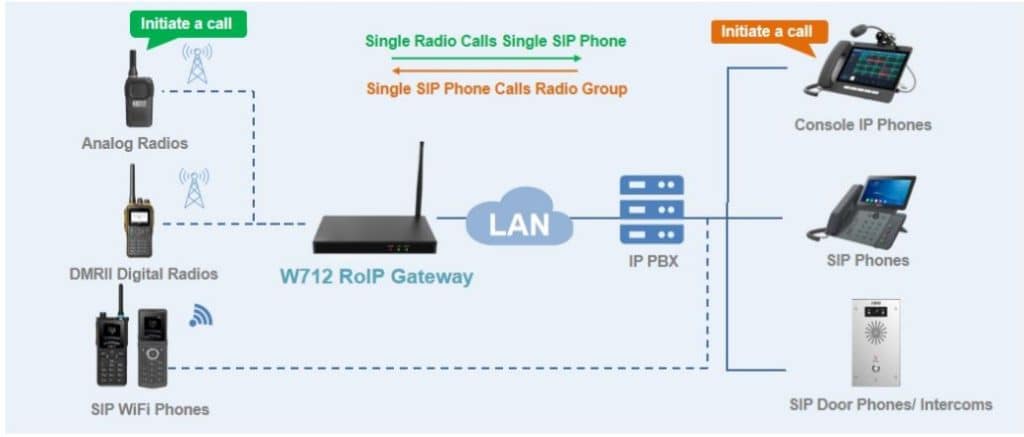
ROIP Radio over Internet Protocol is a device or system used to connect radio communication (such as tactical radios, mobile radios, or other communication systems that use radio waves) with a VoIP (Voice over Internet Protocol) network. By using a ROIP VoIP Gateway, users can integrate their radio devices with the IP network and communicate efficiently over the data network. The Fanvil W712 is a RoIP gateway that can be used to interconnect HTs with a 400-470MHz frequency to VoIP for calls between extensions or other functions. By default, RoIP with a standard open-area signal can reach 1-3 km.
Here are some points about ROIP:
-
Radio Integration with the IP Network: A ROIP VoIP Gateway lets radio devices connect to an IP network, such as the internet or a company intranet. This lets users communicate with radio devices using VoIP software or IP phone devices.
-
Signal Conversion: This gateway converts analog audio signals from the radio device into a digital format that can be transmitted over an IP network. This enables high-quality voice transmission over the data network.
-
Management and Control: A ROIP VoIP Gateway usually comes with software or an interface that lets users manage and control radio communication, including channel selection, radio programming, and other functions.
-
More Efficient Use: Using a ROIP VoIP Gateway can improve radio communication efficiency by letting various radio devices connect to the VoIP network. This can reduce communication costs and enable faster and easier communication.
-
Use in Critical Applications: A ROIP VoIP Gateway is often used in environments that need critical communication, such as the military, law enforcement, firefighters, and other sectors that use radio communication.
By using a ROIP VoIP Gateway, organizations can use VoIP technology to improve the efficiency of their radio communication, integrate it with their existing IP network infrastructure, and optimize the use of their communication resources.
Implementing a ROIP (Radio over Internet Protocol) Gateway involves a number of technical steps and configuration of hardware and software.
Here is a general guide on how you can implement a ROIP Gateway:
- Needs Evaluation: Identify your radio communication needs. Understand the radio devices that will be integrated with the VoIP network, the type of communication protocol used, and the number of devices that will connect. Make sure you have hardware and software suited to these needs.
- Choose a ROIP Gateway Device: Choose a ROIP Gateway device that suits your needs. Various vendors provide these devices, and they can have different features and specifications. Make sure the device you choose supports the type of radio you use and is compatible with the VoIP network to be used.
- Configure the IP Network: Make sure your IP network is ready to accommodate the ROIP Gateway. This includes IP address settings, firewall settings, and port forwarding if needed. Make sure the ROIP Gateway device and the VoIP devices to be connected have suitable IP addresses.
- Install the Hardware: Install the ROIP Gateway device in a suitable physical location. Make sure the device is connected to the radio device to be integrated and also to the IP network. This involves connecting the audio and network cables correctly.
- Software Configuration: Configure the ROIP Gateway software. This involves setting parameters such as the type of radio used, the communication protocol, the IP address of the VoIP network, and others. This configuration will vary depending on the ROIP Gateway device you use.
- Testing and Troubleshooting: Once configuration is complete, run tests to make sure communication between the radio device and the VoIP network works well. Troubleshoot if problems are found, such as unclear audio, delay, or other issues.
- User Training: Make sure the users who will use the ROIP Gateway system have been well trained in its use. Provide guidance on how to operate the device correctly.
- Routine Maintenance: Perform routine maintenance on the ROIP Gateway device and the other devices involved in the system. Check for software updates and fix problems promptly when found.
ROIP Gateway implementation can vary depending on the needs and the devices used. Be sure to follow the device manufacturer’s instructions and involve an experienced VoIP network expert if needed