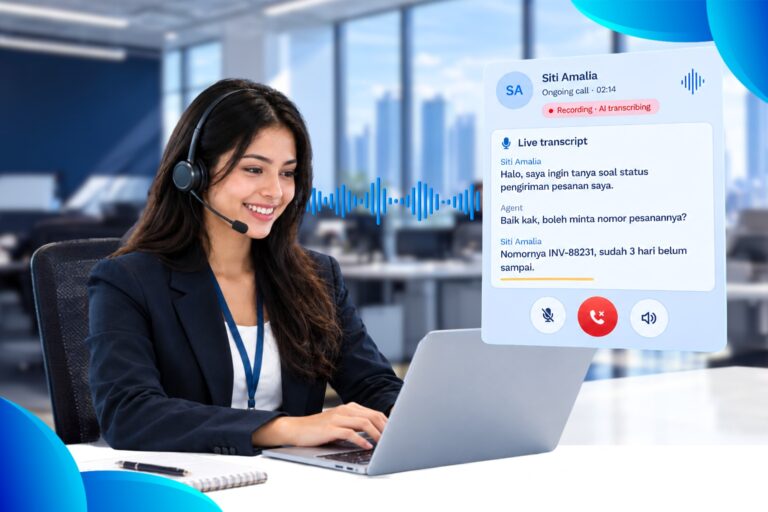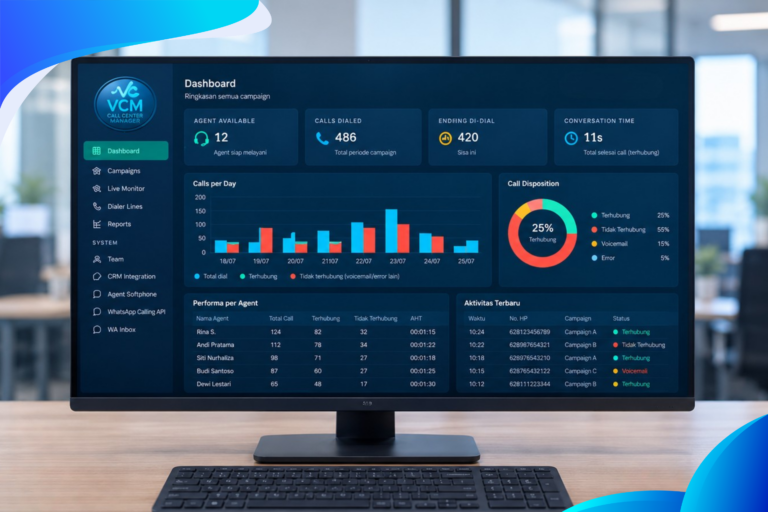


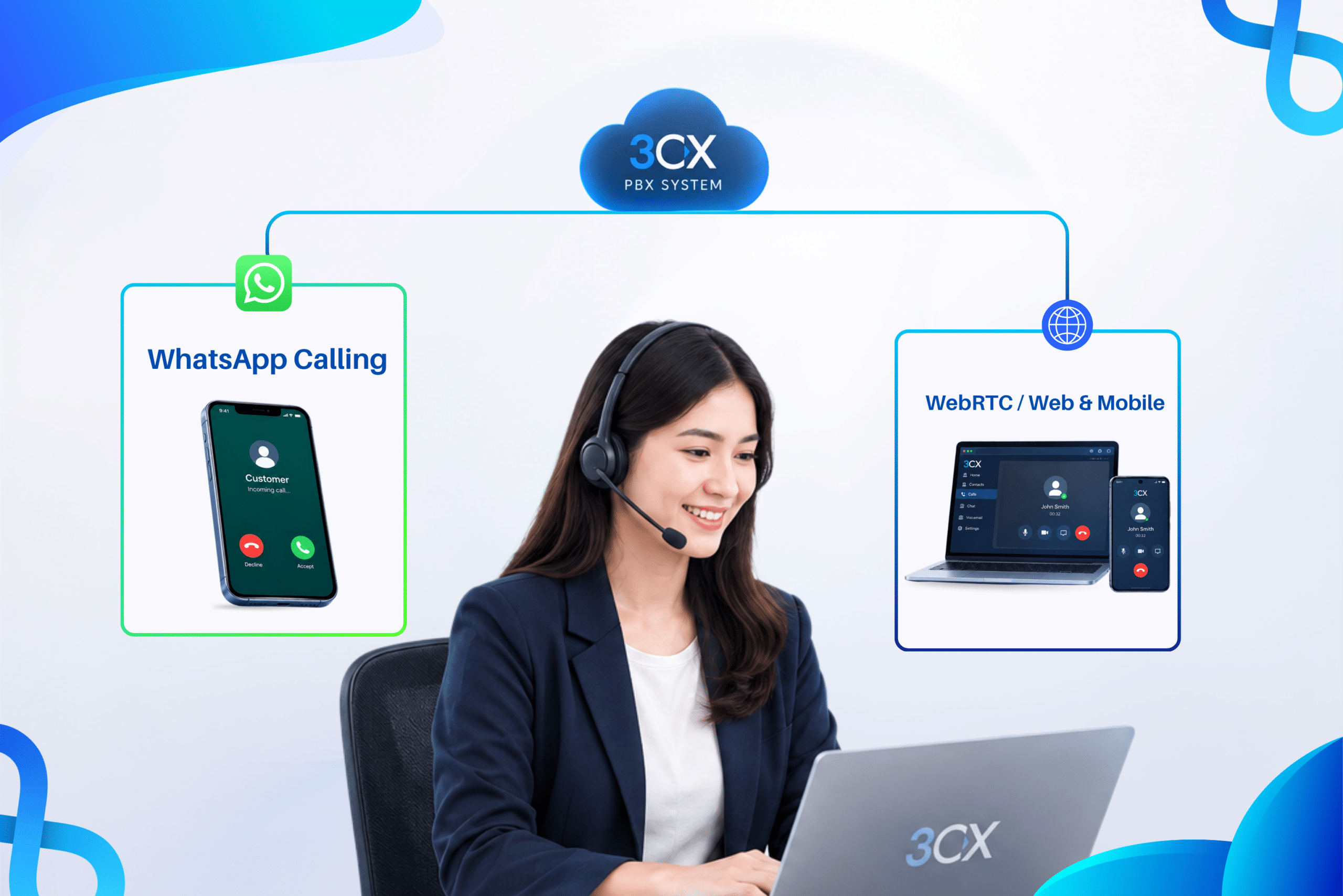

Quick summary (TL;DR): Customer service that relies on only one phone line (a single SIP trunk) risks total paralysis when there is an ISP outage, trunk provider downtime, or PBX server overload. The solution is a multi-channel architecture with fallback: the WhatsApp Business Calling API as a backup calling path that runs independently on Meta’s infrastructure, and VoIP WebRTC embedded directly into the website and Android/iOS mobile apps as a direct communication path from the company’s digital properties. Both can connect to the same PBX system (for example: 3CX), so agents keep working from one dashboard regardless of which channel the customer uses.
What is a single point of failure in customer service?
A single point of failure in customer service is a condition where all customer access to the CS team depends on just one communication path, for example one SIP trunk or one PBX server. If that path is disrupted, all customer communication channels are paralyzed at the same time, with no alternative path to use.
The most common causes:
- ISP disruptions (local/national internet outages)
- Downtime or congestion at the SIP trunk provider
- PBX server overload during simultaneous call spikes
- Internal network problems (router, firewall, office bandwidth)
Why does customer service need more than one communication channel?
Customer service needs more than one channel because a disruption on one communication path is not an “if” scenario but a “when”, and without a backup path, one small disruption can leave customers completely unable to contact the company. With at least two communication paths that are independent at the infrastructure level, when one channel fails, customers still have another way to connect.
What is a fallback channel in a customer service system?
A fallback channel is a backup communication path that automatically or semi-automatically replaces the main path when the main path cannot be reached, without requiring customers to know or understand the technical cause behind it. Ideally, the switch to the fallback channel runs smoothly and with minimal friction for the customer.
How can the WhatsApp Calling API be used as a fallback for customer service?
The WhatsApp Business Calling API can be used as a fallback because calls run on top of Meta’s network infrastructure, which is technically separate from the conventional SIP trunk of a telecommunications provider. When the main SIP trunk or the office ISP has a problem, the WhatsApp path can still be reached as long as the agent’s device has a data connection.
Benefits of the WhatsApp Calling API as a fallback:
- Infrastructure independence from the local phone trunk
- Customer familiarity: most users in Indonesia are already used to using WhatsApp
- Can be integrated into the existing PBX (for example 3CX) through SIP trunking, so calls still arrive in the same agent interface without switching apps
How is WebRTC used to connect customers directly from a website and mobile apps?
WebRTC makes it possible to embed voice calls directly into the company’s website as well as its Android and iOS apps, so customers can press a “Contact CS” button without leaving the app or typing a phone number manually. This path connects to the PBX system through a gateway (for example: Janus Gateway as the WebRTC-to-SIP bridge), and runs independently of the public phone number.
Benefits of embedded WebRTC:
- Zero context-switching for customers
- Independent of the public phone trunk
- Cross-platform: the same core technology can be used in the browser (website) as well as native Android/iOS apps
- Integrated push notifications in the mobile implementation, so incoming calls still feel like a regular phone call even when the app is in the background
What is the difference between a conventional SIP trunk, the WhatsApp Calling API, and embedded WebRTC in terms of infrastructure resilience?
The main difference lies in the infrastructure that becomes the point of failure for each channel:
|
Channel |
Depends on |
Point of failure |
|
Conventional SIP Trunk |
Trunk provider & office ISP |
Trunk/ISP downtime |
|
WhatsApp Calling API |
Meta network |
Independent of the local trunk |
|
Embedded WebRTC (web & app) |
Customer’s internet connection + WebRTC gateway |
Independent of the local trunk |
Why is the combination of the WhatsApp Calling API and embedded WebRTC effective as a fallback strategy?
This combination is effective because both channels run on infrastructure that is independent of the conventional phone SIP trunk, so they do not fail at the same time when there is a trunk or local ISP disruption. When both are connected to the same PBX system, customer service agents can still receive calls from the same dashboard, whichever channel the customer uses.
FAQ
Q: Can the WhatsApp Calling API be integrated with a PBX system like 3CX? A: Yes. With a suitable SIP trunking approach, incoming calls from the WhatsApp Business Calling API can be routed to a PBX system such as 3CX, so agents still receive calls from the same interface.
Q: Can WebRTC be used in Android and iOS apps, not just websites? A: Yes. With the right architecture, the same WebRTC technology can be bridged to the SIP system both for embedding in a website browser and for native Android and iOS mobile apps.
Q: What is the risk if customer service has only one phone channel? A: The risk is that all customer access to customer service can be paralyzed at once when there is a disruption on that single path, whether because of an ISP problem, the SIP trunk, or PBX server overload.
Q: Does a fallback channel require major changes to the existing PBX system? A: Not always. The WhatsApp Calling API and embedded WebRTC can be designed to connect to the existing PBX system (such as 3CX) through SIP trunking and a WebRTC-to-SIP gateway, so agents still work from the same dashboard.
This article was written by the SolusiPBX technical team (solusipbx.com), a provider of cloud PBX solutions based on 3CX, CRM integration, and multi-channel communication architecture for companies in Indonesia. Contact us for a demo