



Transforming Enterprise Phone Architecture with a WebRTC SBC Gateway

Updated on September 30, 2026
2 min read
 #
#
Introduction #
In the era of digital transformation, real-time voice and video communication has become a must-have feature in many business applications. However, connecting traditional SIP (Session Initiation Protocol) based telephony infrastructure, such as an IP-PBX, to modern web- and mobile-based applications often runs into significant technical obstacles.
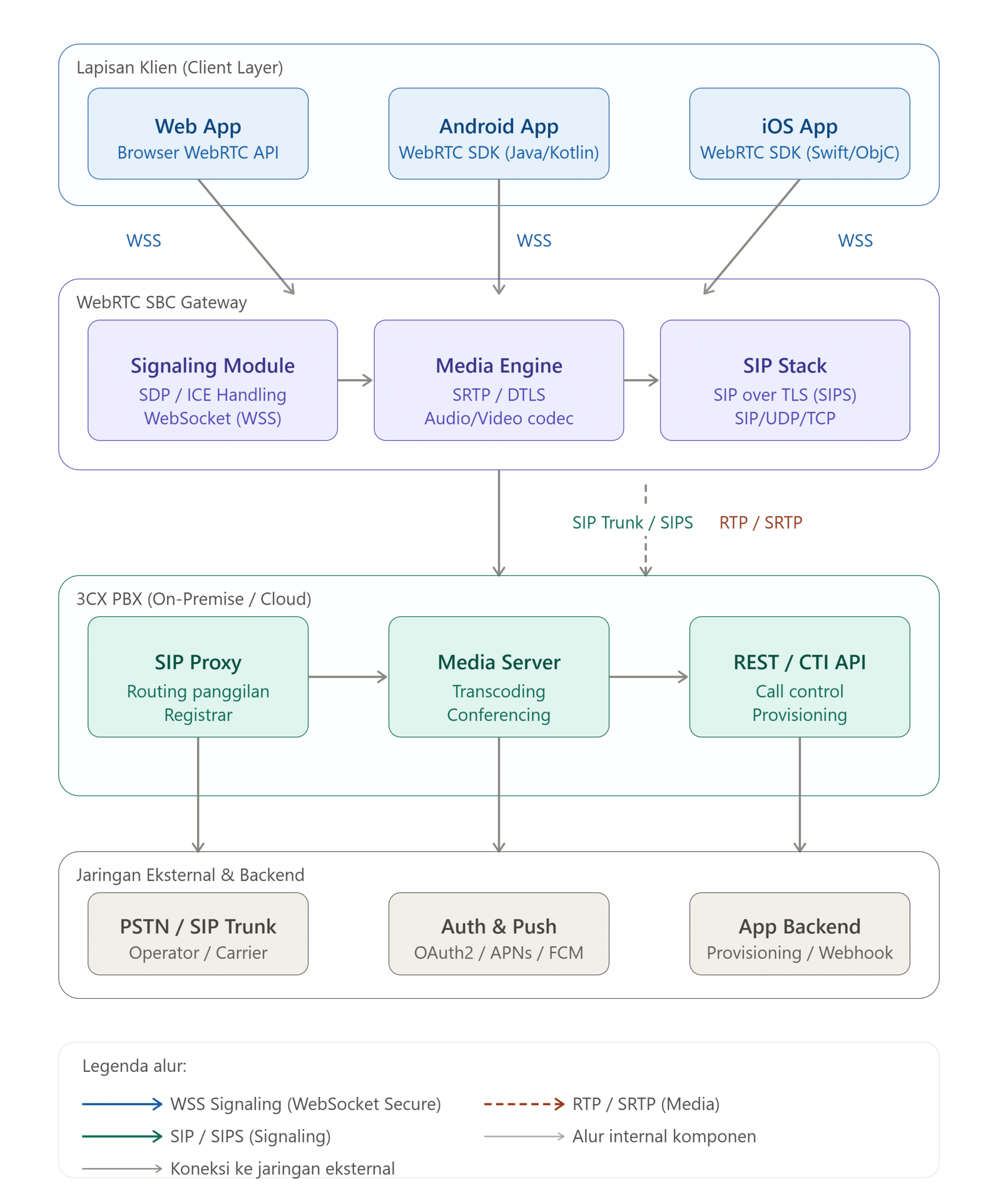
A WebRTC SBC (Session Border Controller) Gateway acts as the bridge between WebRTC (Web Real-Time Communication) and SIP. This gateway translates protocols, secures the connection, and manages communication traffic. As a result, modern browsers and applications can connect directly to your company’s phone system.
What Is a WebRTC SBC Gateway? #
A WebRTC SBC Gateway is a high-performance middleware component designed to handle media sessions and signaling at scale. Where a traditional SBC secures and manages SIP-to-SIP traffic, a WebRTC SBC Gateway goes a step further, performing full translation at the network, signaling, and media layers.
Technically speaking, the gateway acts as:
-
Signaling Translator: Converts the WebSocket- or HTTP-based signaling protocol used by WebRTC applications into SIP messages (UDP/TCP/TLS).
-
Media Transcoder: Bridges the audio/video codec differences between WebRTC (such as Opus and VP8/VP9) and traditional telephony networks (such as G.711, G.729, or H.264).
-
Network & Security Gateway: Solves NAT (Network Address Translation) issues using STUN/TURN servers, while enforcing media encryption (SRTP) and signaling encryption (DTLS).
Key Benefits of a WebRTC SBC Gateway for a Company #
1. Eliminating Third-Party Licensing Costs #
By implementing a custom WebRTC SBC Gateway, a company no longer depends on expensive per-user third-party licenses for internal or external communication needs. This infrastructure stays fully under the control of your own internal IT team.
2. Enterprise-Grade Security #
The gateway isolates the company’s core PBX network from the public internet. Every connection from an external client application is made using full encryption via DTLS-SRTP. On top of that, the SBC’s built-in functionality protects the system from DoS/DDoS attacks and signaling packet spoofing.
3. High Scalability with Low Resource Consumption #
This gateway is built with a lightweight, modular structure. On top of that, the use of an efficient programming language lets it handle thousands of concurrent calls. As a result, server resource requirements stay lower.
Advantages for Custom App Development (Web, Android, & iOS) #
For development teams, building custom voice/video call features directly into business applications (such as a CRM, ERP, or self-service app) often runs into the complexity of traditional telephony SDKs. A WebRTC SBC Gateway removes that friction through the following advantages:
A. Web-Based Applications (Native Browser) #
-
No Plugins or Extensions: Since modern browsers (Chrome, Safari, Firefox, Edge) support WebRTC natively, developers don’t need to ask users to install any additional app or plugin.
-
Custom UI Integration: Phone calls can run in the background of a web page. Developers can design buttons, customer-data pop-ups, and call indicators using standard HTML, CSS, and JavaScript/TypeScript.
B. Android Applications #
-
Lightweight, Battery-Friendly SDK: Instead of embedding a heavy SIP stack in Android, developers can simply use the far lighter standard WebRTC library.
-
Seamless Mobile Network Handling: The gateway supports ICE (Interactive Connectivity Establishment) technology, which keeps calls connected without dropping even when the user switches from Wi-Fi to mobile data (4G/5G).
C. iOS Applications #
-
Full Compatibility with the Apple Ecosystem: WebRTC on iOS can be seamlessly integrated with native Apple APIs such as CallKit (to show a native-looking call screen even when the device is locked) and PushKit (VoIP Push Notifications) for better battery efficiency.
-
Optimal Audio Performance: The gateway intelligently adjusts bandwidth allocation and Opus audio quality to match the audio hardware controls on iPhone and iPad devices.
Conclusion #
A WebRTC SBC Gateway is an essential foundation for companies that want to build their own Unified Communications platform independently. With reliable protocol translation, high resource efficiency, and proven support for Web, Android, and iOS development, this gateway lets your business deliver a seamless, secure, and borderless communication experience straight from your own custom application.